Michael Sheroubi
Relevant Experience
Computing Graduate Research Intern 2025 (4 months)
Lawrence Livermore National Laboratory
- Developed a novel multimodal alignment architecture extending CLIP beyond two modalities.
- Explored Flow Matching to bridge modality latent spaces.
- Conducted large-scale training experiments and ablation studies on HPC clusters to validate scalability and robustness.
- Synthesized insights from state-of-the-art research papers to guide experimental design and knowledge sharing.
- Worked on two additional projects; resin activation image classification using traditional image processing, and error correction in metrology machines using traditional machine learning.
Machine Learning Engineer 2024 (9 months)
EdgeTunePower
- Designed, built and optimized deep reinforcement learning (DRL) models for real-time optimal power flow on a simulated electric grid.
- Developed and trained a machine learning model to flag anomalies from a real-time simulated electric grid.
- Established ETL pipelines connecting data from real-time industrial controls to the cloud.
- Conducted advanced research in deep reinforcement learning and power systems.
Data Analyst 2023 (6 months)
Asurion LLC | Roubi
- Fine-tuned a large language model for zero-shot classification of ineligible products.
- Developed a clustering algorithm using NLP and cosine similarity, reducing the workload of the Digital Mapping team by an average of 88% per batch
- Designed a suite of testing scripts to help automate QA by cross referencing data across multiple batches.
- Contributed to a collaborative team project focused on developing a machine learning classifier.
Data Analyst & Support 2020-2023
Clearmind International | Roubi
- Developed an ETL solution using Python to migrate over 7 years of historical data; from legacy systems & csv files to a cloud-based solution.
- Designed OLTP database to handle simultaneous transactions by 20+ instructors while maintaining ACID compliance & data integrity.
- Normalized transcript data to improve query performance, reducing query run-time by over 75% and increasing accuracy of search results.
- Optimized registration process by modelling its flow of data and removing waste, trimming operational costs by 23%.
- Ensured enterprise-wide compliance with federal & international data protection regulations
Data Warehouse Engineer 2019-2020
Trellis Social Enterprise | UBC
- Designed, developed, and implemented a data warehouse solution using AWS Redshift to house data from the production mongoDB along with data from 5 3rd party sources.
- Developed an ETL solution (from the ground up) to migrate data in batches from mongo DB to the data warehouse using Python & windows task scheduler.
- Created automated test procedures to validate data integrity.
- Designed complex SQL procedures called by the company's internal dashboard.
Mistral AI Robotics Hackathon - 1st Place
Using SO100 Arm with HuggingFace's LeRobot
This project showcases a mix of traditional robotics (optimal control) and AI Robotics (in this case we used Action Chunking Transformers). For the movement we went with a coded algorithm following an image processing pipeline. For detecting trash, we used a VLM with in-context learning. For the robotic arm policy, we used ACT with ~150 demonstrations. The robot was able to pick up trash and place it in a bin. The project was built in 36 hours and won first place at the Mistral AI Hackathon in Paris.
Active 3D Scene Exploration with a Robotic Arm
Robotics, Computer Vision, Reinforcement Learning
A complete pipeline for autonomous 3D scene exploration using a 6-DOF LeRobot SO-101 arm with a wrist-mounted camera. The system iteratively captures images, reconstructs the scene using the VGGT foundation model, builds a tri-state occupancy grid via 3D DDA ray-casting, and selects the next-best viewpoint to maximise coverage. A PPO-based RL agent with a 3D-CNN policy was developed and trained purely in an analytic simulator, with a thorough comparison against an exact ray-cast scorer.
EMOTE: Visual Shader for Socio-Emotional Agents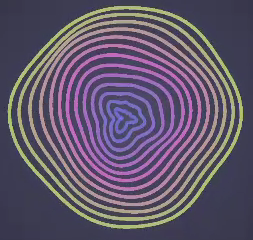
HCI, Affective Computing, NLP, Unity
EMOTE is a procedurally generated visual shader that communicates an AI agent's emotional state through shape, motion, and color — without using a face. Grounded in perceptual psychology (kiki–bouba shape–emotion links, color–arousal correspondences), the blob representation allows users to interpret affect while maintaining a clear boundary between AI and human. Built end-to-end in Unity with local Whisper STT, Gemma 3 (1B) via Ollama, a fine-tuned DistilBERT emotion classifier, and Piper TTS. Validated with a user study (N=12): 11/12 participants preferred the blob over a facial agent.
Ice World: Algorithms
Unity · Procedural Generation · Simulation · RL · Wave Shaders
A suite of interconnected procedural and simulation systems built in Unity: an organic medieval village generator (random-walk roads, mesh batching), icicle and castle mesh tools, a recursive fractal snowflake, Gerstner wave shaders with synchronized GPU/CPU buoyancy physics, a boids flocking simulation with cylindrical bounds, a tabular Q-learning wolf pack hunter with species-specific prey AI, Catmull-Rom ski path generation, and a deferred terrain-carving snowball.
Comparing Spatial Reasoning in Discrete Environments
From Mistral Game Jam - Hackathon by Spotlight Paris (Entrepreneur First)
This study compares the performance of a Multimodal Model (Pixtral Large) and a Large Language Model (Mistral Large) in navigating identical game states. The Multimodal Model processes image based inputs, while the LLM relies on textual descriptions derived from the same images. The evaluation focuses on their decision-making, reasoning, and adaptability to provide insights into their respective strengths and limitations
Four Leaf Clover Detection
Computer Vision, Machine LearningUsing image processing to detect four leaf clovers
This project involves using computer vision techniques to detect four leaf clovers in images. The algorithm processes the image to identify and count the number of leaves, distinguishing four leaf clovers from the common three leaf variety. This project demonstrates the application of image processing and machine learning in a fun and practical way.
Roubi Analytics
Founder & CTO Data & AI Research & Consulting
This company started as a way to help small businesses make data-driven decisions & build out their data infrastructure. With time I acquired bigger clients with multiple recurrent contracts working on AI projects.
After a personal shift in priorities, the company now focuses on supporting AI research and deployment in critical systems & infrastructure.
I have since expanded the company to include a small team of researchers and engineers, with our ethos being "AI for Good".
Run-AI
AI, Computer Vision, Machine Learning Using OpenCV to train a Convolutional Neural Network
This AI is designed to play the popular flash game "Run". I acted as sole/principal developer for this project. Using OpenCV's edge detection and a movemement vector as input, an image classification CNN, AlexNet, was fed hours of gameplay data to train the model. This project was meant to serve as an introduction into Machine Learning, but turned out to also be a great lesson in computer vision and image processing.
TALK TO ME ABOUT THIS!
GovDB
Large Scale Web-Scraping, Vector Databases, Search Engine Vector Database housing meeting minutes from municipal governments accross Canada
Designed to help contractors find and bid on government contracts. The database is updated routinely with meeting minutes from municipal governments across Canada. The search engine uses a vector database to find relevant documents based on user queries. Documents are split into chunks and converted into vector embeddings.
Sudoku 
Algorithms and Data Structures, Problem Solving, P vs NP Failed attempts at solving sudoku in polynomial time
Periodically I to try and find an algorithm for a sudoku solver in polynomial time. One of my latest attempts involved converting a sudoku board into a system of equations and attempting to solve that. Other attempts included starting with a completed board and shuffling rows and columns (like a rubix cube) to match hints on starting board. I eventually hit a wall, but every idea is always very exciting. I obsessively chase each idea and enjoy each attempt.
TALK TO ME ABOUT THIS!
Analog Clock Reader 
Computer Vision, Problem Solving, Test AutomationRead time from an Analog Clock
The purpose of this project is to develop an algorithm for analog clock identification and to implement a program that would be able to read a given image or feed and return the value displayed. This is achieved broadly in three steps: find the clock, identify the centre, and highlight hands. The code utilizes Canny edge detection with Hough transform, and by calculating the angles between the hands to return the time. In the future, the code can be tweaked to read any kind of analog instrument, like gauge readers.”.
Benchmarking graph database performance 
Databases, SQL/NoSQL, Query OptimizationHonours Thesis
Comparing the performance of Neo4j and SQL Server inside a social media application. The first phase involved data modelling, making application architecture decisions, and generating & importing data. The focus shifted towards designing queries to get information from the social network. The final phase was creating test procedures that collected perfomance data for each database.
Nova-Graph 
Databases, Graph Theory, Natural Language ProcessingGraph Theory and NLP Research
A new approach towards building the "memory" of a virtual agent, NOVA. The aim is to create a knowledge-graph in high-dimensional space. Nodes would form relationships based on their position in this space. Their position in this space will change based on input from training texts. In short, each word would be defined by its neighbours inside this graph. The challenge is how to extract meaningful relationships and nodes from a piece of text (Big NLP Problem 1) and how to display query results in a meaningful output (NLP Problem 2).
TALK TO ME ABOUT THIS!
Contact: Email: devsheroubi [at] gmail.com Github: @msheroubi
Education
MScT Artificial Intelligence and Advanced Visual Computing
Ecole Polytechnique - IP Paris
Expected Graduation 2026
BSc. Honours Computer Science
University of British Columbia
Minor in Mathematics
Specialization in Data Science
GPA 3.90/4.33
CompTIA Security+
Google Data Analytics
Neo4j Certified Professional
Skills
Automation & Scripting Reinforcement Learning Advanced Research Machine Learning Data Analysis ETLTool Box
Languages: Python SQL Java RLibraries / Frameworks: PyTorch
Pandas Gym OpenCV TensorFlow Django
Other: Excel Git
Areas of Interest Deep Reinforcement Learning
Natural Language Processing Artificial Intelligence
Graph Theory
Capstone Peer Evaluations
Personal Statement
In every position I have held, the scope of my responsibilities has always grown broader than the job description.
When I see an opportunity to improve an existing process, I take the initiative to do so even if it's on personal time.
Most of my technical experience comes from me taking initiative in finding the optimal solution to both
new and known challenges.
During my time at Asurion, I wrote various Python scripts to help scrape and
wrangle data to prepare data going into a machine learning classifier. Almost all these projects
were developed on personal time and were later added to the production workflow. The apex of these
projects was the development of my own classifier powered by a large language model. From gathering
and preparing data to training and testing the model, I was the primary contributor to this ineligibility
classifier which has since been deployed into production.
I strive to develop a combination of technical, business, and interpersonal skills which allow me to adapt to the complexities of different roles.
Through my time at Clearmind, I collaborated with people from various teams & backgrounds, which
greatly enhanced my communication and presentation skills. The ability to communicate technical
information effectively allowed me to fit seamlessly with different departments ranging from Sales and
Marketing to IT and Management. I was the primary stakeholder in muplitple major projects during my time at Clearmind, which taught
me the importance of project management and the value of a well defined scope.
I am a self-starter who is always looking for ways to improve and learn. I like what I do and I am always looking for ways to do it better.